Purpose
The DIR Fundamentals course is designed to cultivate the
essential techniques required by all sound diving practice, irrespective of
level or environment. Functioning as a prerequisite for all other GUE classes,
save its recreational diver course (forthcoming), DIR Fundamentals
performs a three-fold function within the GUE curriculum: 1) it provides the
recreational diver, in whom there is no desire for further diver training, with
a context in which to advance his/her basic diving skills, thereby developing
more comfort, confidence, and competence in the water; and 2) it provides the
diver with aspirations of more advanced diver training with the tools that will
contribute to a greater likelihood of success; and 3) it provides non-GUE
trained divers with a gateway into GUE training.
Prerequisites
- Must
meet GUE General Course Prerequisites as outlined in Section 1.6
- Must be a minimum of 16 years of age
- Must be a certified open water diver from a recognized training agency
- Must be able to swim a distance of at least 50 feet/15 meters on a breath hold
- Must be able to swim at least 300 yards/275 meters in less than 14 minutes
without stopping. This test should be conducted in a swimsuit and, where
necessary, appropriate thermal protection.
Duration
The DIR Fundamentals class is normally conducted over a 2-
to 3-day period. It involves a minimum
of twenty (20) hours of instruction, encompassing both classroom and in-water
work.
Course Limits
- General Training Limits as outlined in Section 1.4
- Student
to instructor ratio is not to exceed 6:1 during any in-water training and
should be adjusted downward to account for bad conditions and/or poor
visibility
- Maximum depth 60 feet/18 meters
- No decompression
- No overhead environment diving
Course Content
The DIR Fundamentals course is normally conducted over a 2-
to 3-day period. Combining lecture and
practical (in-water) sessions, this course focuses on cultivating the
foundational skills required by all diving practice.
It is focused on increasing diving fun by reducing stress and increasing diver
proficiency through proper control of buoyancy, trim, propulsion, teamwork, and
other DIR principles.
Course requirements include a
minimum of eight (8) hours of academics and four (4) in-water sessions.
Required Training Materials
- Doing it Right: The Fundamentals of Better Diving. Jarrod Jablonski, GUE, 2001, High Springs, Florida.
- DIR Fundamentals Workbook.
Academic Topics
- GUE
organization
- Why DIR Fundamentals?
- Diving proficiency
- Buoyancy and trim
- Streamlining and equipment configuration
- Propulsion techniques
- Situational awareness
- Communication
- Breathing gas overview
- Dive planning and gas management
- Diver
preparedness
Land Drills & Topics
- Dive
team protocols
- S-drill
and valve-drill
- Equipment
fit and function
- Propulsion
techniques
- Pre-dive
drills
- Surface
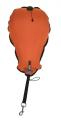
marker deployment
Required Dive Skills & Drills
- Demonstrate
proficiency in safe diving techniques; this would include pre-dive
preparations, in-water activity, and post-dive assessment.
- Demonstrate
awareness of team member location and a concern for safety, responding
quickly to visual cues and dive partner needs.
- Efficiently
and comfortably demonstrate how to donate gas to an out-of-gas diver.
- Efficiently
and comfortably demonstrate how to donate gas to an out-of-gas diver
followed by a slow, direct ascent to the surface.
- Comfortably
demonstrate at least two propulsion techniques that would be appropriate
in delicate and/or silty environments.
- Demonstrate
a safe and responsible demeanor throughout all training.
- Demonstrate
proficiency in the ability to deploy a spool and a surface marker.
- Demonstrate
good buoyancy and trim.
- Demonstrate
proficiency in underwater communication.
- Demonstrate
basic equipment proficiency and an understanding of the DIR equipment
configuration.
- Demonstrate
aptitude in the following open water skills: mask clearing, mask removal
and replacement, regulator removal and exchange, long hose deployment.
- Demonstrate
safe ascent and decent procedures.
- Demonstrate
proficiency in executing a valve drill.
Equipment Requirements
Each student should have, and be familiar with, all of the
following required equipment.
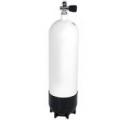
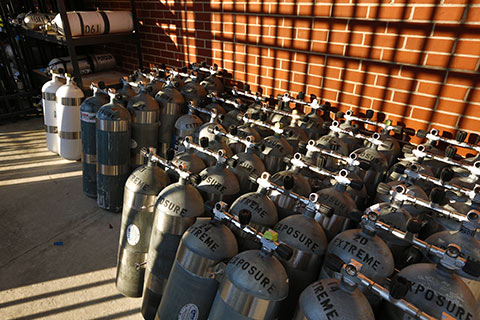
- Tanks/Cylinders: Students may use dual
tanks/cylinders connected with a dual outlet isolator manifold, which
allows for the use of two first-stages. Students may also use a single
tank/cylinder with a K, H, or Y-valve.
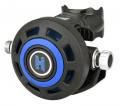
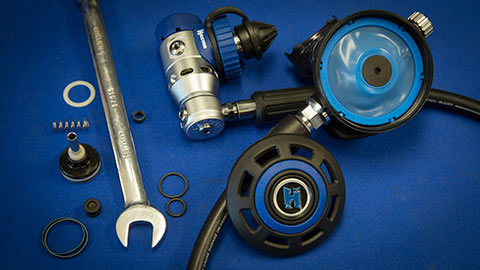
- Regulators: One of the
second-stages must be on a 5- to 7-foot/1.5- to 2-meter hose. One
of the first-stages must supply a pressure gauge and provide inflation for
a dry suit (where applicable).
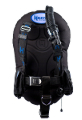
- Backplate System: A rigid and
flat platform, of metal construction with minimal padding, held to a diver
by one continuous piece of nylon webbing. This webbing should be
adjustable through the plate and should use a buckle to secure the system
at the waist. A crotch strap attached to the lower end of this platform
and looped through the waistband would prevent the system from riding up a
diver's back. A knife should be secured to the waist on the left webbing
tab. This webbing should support five D-rings; the first should be placed
at the left hip, the second should be placed in line with a diver's right
collarbone, the third should be placed in line with the diver's left collarbone,
the fourth and fifth should be affixed to the crotch strap to use while
scootering or towing/stowing gear. The harness below the diver's arms
should have small restrictive bands to allow for the placement of reserve
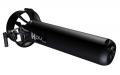
light powered by three in-line c-cell batteries (where necessary). The
system should retain a minimalist approach with no unnecessary components.
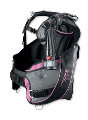
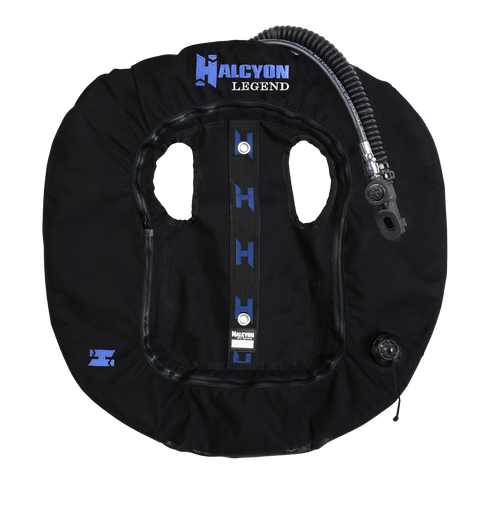
- Buoyancy Compensation Device: A
diver's buoyancy compensation device should be back-mounted and minimalist
in nature. It should come free of
extraneous strings, tabs, or other material. There should be no
restrictive bands or "bungee" of any sort affixed to the buoyancy cell. In
addition, diver lift should not exceed 50lbs for a single tank and 80lbs
for double tanks. Wing size and shape should be appropriate to the
cylinder size(s) employed for training.
- At least one depth-measuring device
- At least one timekeeping device
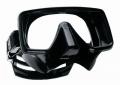
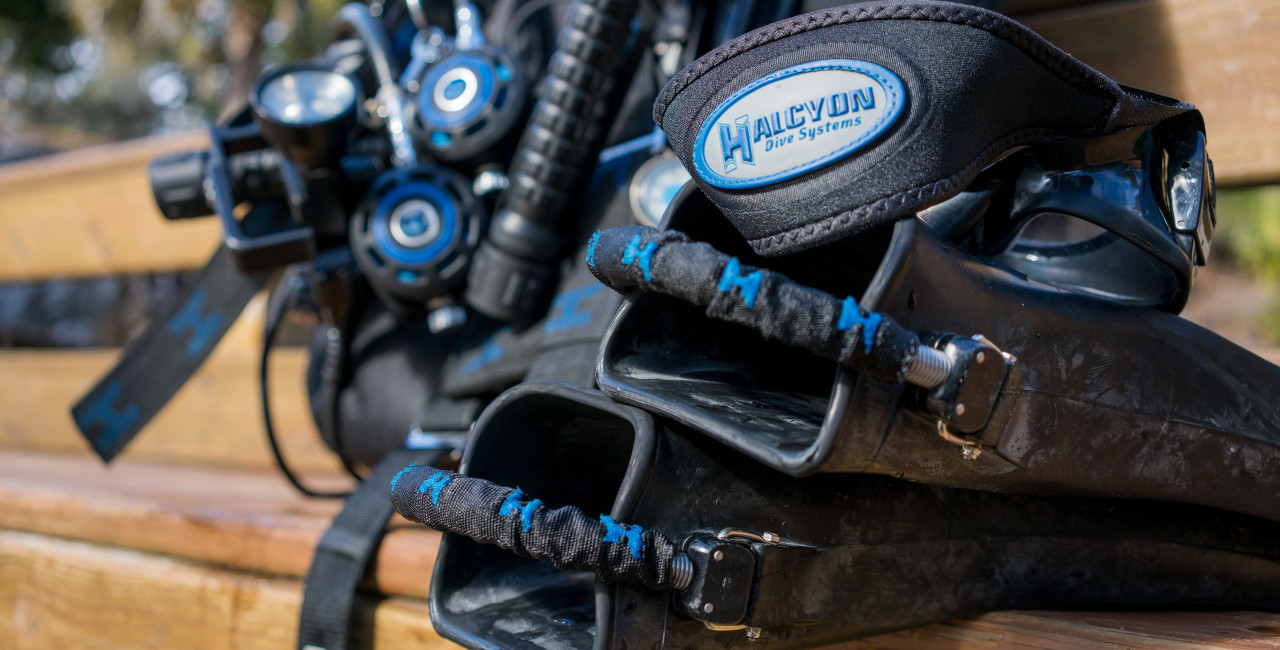
- Mask and fins: Mask should be low volume; fins should be rigid,
non-split
- At least one cutting device
- Wet Notes
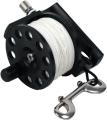
- One spool with 100 feet/30 meters of line per diver
- Exposure suit appropriate for the duration of exposure
Note: Prior to the commencement of class, students should
consult with a GUE representative to verify equipment requirements. Whether or
not a piece of equipment fulfills GUE's equipment requirement remains at the
discretion of GUE and its instructor representatives. Participants are responsible for providing all equipment or for
making provisions to secure the use of necessary equipment before the start of
the course. In general, it is better for the student to learn while using his
or her own equipment. However, students
should exercise caution before purchasing new equipment to avoid acquiring
substandard equipment. Please contact a GUE representative prior to making any
purchases. Information about recommended equipment can be obtained from the
equipment considerations section of GUE's web site.